Introduction
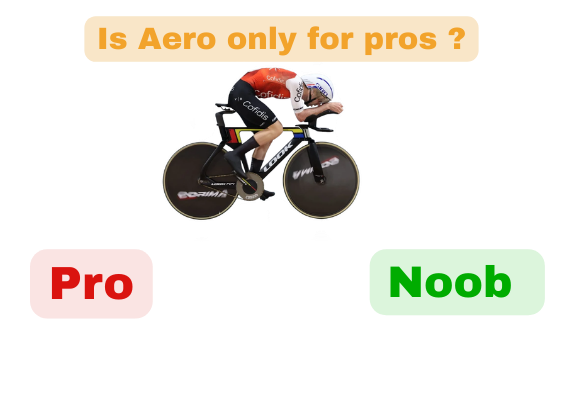
Many cyclists think:
“Aerodynamics is for the pros.”
“Below 40 km/h, it doesn’t make much difference.”
That’s wrong.
The laws of physics are identical for everyone.
And in reality, aerodynamics can represent a much more decisive time-saving lever for amateurs than for professionals.
Let us explain.
At what speed does aerodynamics start to matter in cycling?
Aerodynamic drag becomes the dominant force from just 15 km/h, where it already represents over 50% of total resistance on flat terrain. At 30 km/h, it reaches approximately 80%. Aerodynamics therefore concerns all cyclists, not just those riding above 40 km/h.
Aerodynamic drag (CdA): the resistance force exerted by air on a moving cyclist. It depends on the frontal area (A), the drag coefficient (Cd), and the square of speed. The product CdA (Cd × A) is the key metric: measured in m², it typically ranges from ~0.20 m² (optimized TT position) to ~0.40 m² (upright road position).
In other words: Even at “moderate” speed, air is already your main opponent.
Why do amateurs gain more time than pros by optimizing their aero?
We often hear:
“Pros ride faster, so aerodynamics matters more for them.”
That is partially true… but incomplete.
The reality is that when aerodynamic drag is reduced by 10%, the power saved is also close to 10% as early as 20 km/h. This leads to a speed increase of around 3% at constant power.
This reality is true for everyone.
Concretely, that means going from 40 km/h to 41.2 km/h, and from 20 km/h to 20.6 km/h.
So yes, the faster you ride, the greater the impact aerodynamics has on your speedometer. And gaining a few tenths of km/h may seem negligible at first glance…
And this is where a huge misunderstanding causes amateurs to lose a lot of time on their results…
👉 Let’s talk about time gains
When you ride at 40 km/h, 1 km takes 1 minute 30 seconds. At 41.2 km/h, it takes 1 minute 27 seconds.
When you ride at 20 km/h, 1 km takes 3 minutes. At 20.6 km/h, it takes 2 minutes 55 seconds.
In other words, when a fast cyclist improves aerodynamics by 10%, that’s 3 seconds gained per km. For the amateur riding half as fast, that’s more than 5 seconds gained per km!!!
Amateurs therefore have much more to gain on their overall times by optimizing their aerodynamics.
Source: S'entraîner à l'aérodynamisme (O. Demichel, 2026), table 2.3. At the same power as the upright position.
The chart above shows the gains you can target when moving from an upright position to an optimized aerodynamic position on a road bike or on a time trial (or triathlon) bike. And yes, your position can help you gain up to 20 seconds per kilometer when riding at 20 km/h… The effect is amplified over long distances, and on an Ironman (180 km), the impact becomes even more spectacular. When an amateur is aiming to beat cut-off times, position therefore becomes crucial.
How much time can you save over 40 km by optimizing your position?
A 10% improvement in aerodynamics saves approximately 2 minutes 20 seconds over 40 km for a cyclist riding at 32 km/h, compared to only 1 minute 40 seconds for a cyclist at 45 km/h. The slower you ride, the greater the absolute time savings from aerodynamic optimization.
Let’s imagine two cyclists who both improve their aerodynamics by 10%. One initially rides at 45 km/h, the other at 32 km/h.
Estimated gain:
- At 45 km/h → about 1 minute 40 seconds over 40 km
- At 32 km/h → about 2 minutes 20 seconds over 40 km
The time gain is therefore always greater for the slower cyclist.
Over an Ironman distance (180 km), a 10% CdA improvement allows an amateur riding at 30 km/h to save more than 10 minutes on the bike leg — without producing a single extra watt.
Aero position vs. power: which is the better investment?
For an amateur:
- Increasing FTP by 20 watts requires months of training.
- Reducing CdA by 8 to 12% can be achieved in a few weeks.
And above all:
👉 Position is a free lever.
No need to buy a $10,000 bike.
No need for exotic sensors.
It is about learning to:
- Optimize your position
- Hold that position
- Be powerful in that position
Why do most cyclists neglect aerodynamics?
Most cyclists ignore aerodynamics because it is invisible: unlike power (displayed on the computer) or heart rate (physically felt), aerodynamic drag produces no perceptible signal without dedicated tools. Three main reasons:
- Lack of real-time feedback
- Difficulty in feeling aerodynamic drag
- Excessive focus on power
Power is visible.
Aerodynamics is invisible. But AeroX definitively changes that!
Therefore, it is neglected.
Conclusion
Aerodynamics is not reserved for elites.
It is even more profitable for amateurs.
The real question is not:
“Do I ride fast enough for aerodynamics to matter?”
But rather:
“How many minutes am I willing to leave on the road?”
Frequently Asked Questions
Does aerodynamics matter below 30 km/h?
How much time can you save on an Ironman with better positioning?
What is CdA in cycling?
Is it better to train harder or improve your position?
How can you measure your aerodynamics without a wind tunnel?
Read more: